Copy Direction for Bella Freud
Collaborated with Bella Freud on her eponymous brand, writing seasonal press releases and developing About Us copy for the website.
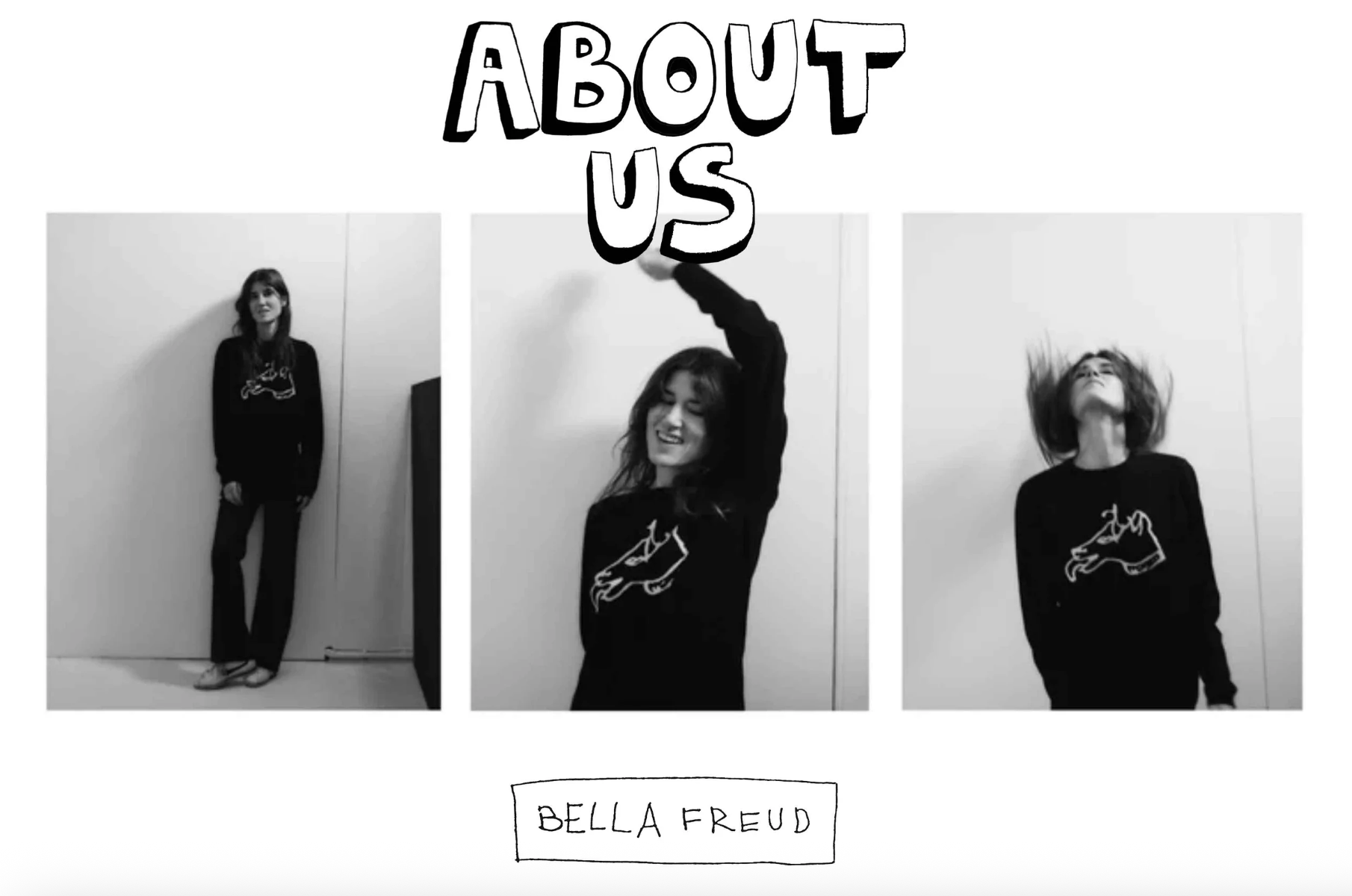
Since establishing her eponymous label in 1990, Bella Freud has redefined what it means to be a designer, moving seamlessly across fashion, interiors, perfumery, filmmaking, and publishing. Along the way, she has collaborated with leading names in these fields, shooting films directed by John Malkovich, publishing the magazine Memo with Anita Pallenberg, designing a penthouse at Television Centre in London, creating knitwear with Nick Cave, collaborating with Marks & Spencer and King & McGaw, and launching the viral Fashion Neurosis podcast. Meanwhile, her clothing has garnered a cult following, worn by Kate Moss, Julianne Moore, Scarlett Johansson, Sienna Miller, and Zadie Smith.
Launched in October 2024, Fashion Neurosis with Bella Freud has quickly become a sensation, reaching number one in the UK arts podcast charts and the top ten globally. Set in the intimate and instantly recognisable environment of Bella's sitting room, each episode sees Bella Freud invite a guest to lie on the couch—a playful nod to her great-grandfather Sigmund Freud—and explore the connection between fashion and identity. These deeply personal conversations examine how style is one of the most immediate and universal languages with which we communicate ourselves to the world. Through a series of specifically tailored questions, Bella delves into broader themes—love, identity, culture, and self-consciousness—creating a relaxed and open space for her guests. The podcast has featured an eclectic mix of luminaries from her community, including the usually reclusive Kate Moss, fashion designers Rick Owens and Jonathan Anderson, actors Cate Blanchett and Julianne Moore, writers Zadie Smith and Karl Ove Knausgaard, and Nick Cave. Available on Spotify and YouTube, with audio also on Apple Podcasts, Fashion Neurosis challenges the notion that fashion is superficial, instead using it as a lens through which to explore our inner lives, relationships, and society.
For Bella, design is about distilling an emotion into a statement. Her iconic word jumpers reflect her intelligent yet playful approach, weaving personal narratives throughout her collections. The Ginsberg is God sweater originated from her short film Hideous Man (2002), while the 1970 jumper was inspired by a catalogue she was leafing through, its typography evoking the energy of the early punk scene. Even the Bella Freud logo has a personal connection, designed by her father, the painter Lucian Freud, during a sitting. Her stories, including memories of seeing Kate Moss—a Fashion Neurosis guest—for the first time through a taxi window in Paris or a night out with Diane von Furstenberg in New York, are chronicled in the Sunday Stories section of her website, which serves as both an illustrated journal and e-commerce platform.
Bella’s distinctive visual identity is in part inherited. She cites her father Lucian’s grey flannel Huntsman suits, handmade shirts, and paint-splattered chef trousers as early sartorial influences. Sigmund’s theories on unconscious thought, emotion, and desire manifest in the spontaneity of her designs. Her career began in the 1980s with Vivienne Westwood, first as a teenager at the legendary Seditionaries store, later becoming Westwood’s assistant before launching her own label.
By 2012, Bella had expanded into a lifestyle brand, launching Bella Freud Parfum and a homeware range. Her first standalone boutique opened in 2015 on Chiltern Street, Marylebone, designed to reflect her personal aesthetic with reclaimed stone floors, bespoke brass rails, and velvet carpets. Her clothing possesses an inherent fluidity; their ease and versatility complement rather than overpower the wearer.
Bella has long been engaged in visual art, moving between it and other creative disciplines. In June 2021, Sotheby’s invited her to curate their summer season, where she designed the look of the space, scrawling artist names—including Chris Ofili, Claude Monet, and Gerhard Richter—across the walls. As part of her ongoing collaboration with King & McGaw, Bella translated her word-based artwork into limited-edition prints, shifting her canvas from clothing to paper, with hand-embossed stamps adding to their collectability.
The end of 2024 was a significant period for the brand. Bella unveiled a capsule collection with Marks & Spencer alongside her podcast and print collaboration launches. Featuring knitwear, pinstripe tailoring, mid-rise flared jeans, and accessories, the 26-piece collection referenced the British retailer’s heritage while remaining distinctly her own. Conducting primary research at M&S’s Leeds archive, she developed a range that resonated with a broad audience. Stocked in major M&S stores and online, the ready-to-wear pieces sold out within a day.
Much like a cinematographer, Bella approaches her brand holistically, making film a constant thread in her career. She draws inspiration from Jean Cocteau’s La Belle et la Bête and Luis Buñuel’s Belle de Jour, presenting some of her earliest collections as films. To date, she has created eight films, including More Clothes (1992), Lady Behave (2000), and Submission with BAFTA Award-winning director Martina Amati.
For Bella, imagery alone is not enough—film is her most immediate and nuanced way of communicating ideas. Fashion, while central to her work, ultimately serves the individuals who wear it. Bella Freud’s world is one of uninhibited creativity, where style and substance are seamlessly intertwined, and every piece tells a story as compelling as the medium through which it is expressed.